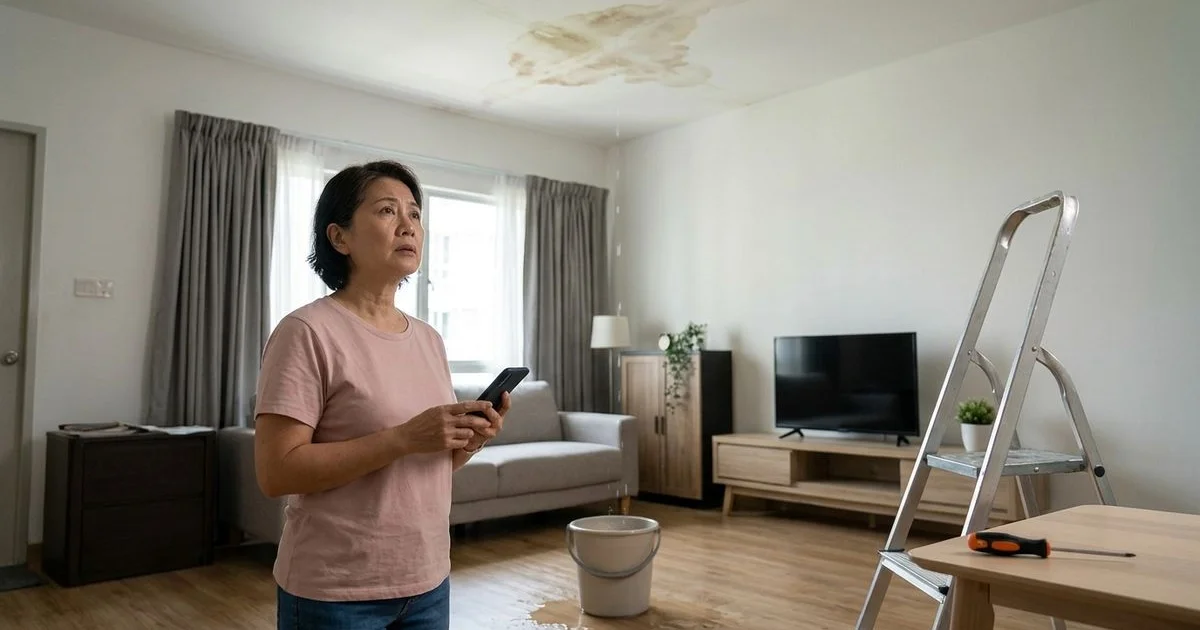
We constantly see property owners panic when they spot sagging ceilings, assuming the worst about their timber framework. Finding out your structural timber has degraded brings up an urgent question about Roof Truss Repair vs Full Replacement: When to Decide.
This choice is rarely a simple coin toss.
Our professional service team assesses these structural challenges across Malaysian properties every single week. From field experience, making the wrong choice here can either waste thousands of Ringgit or leave a dangerous structural weakness overhead. We are going to walk you through exactly how to evaluate the damage objectively, compare realistic costs, and explain local council permit requirements.
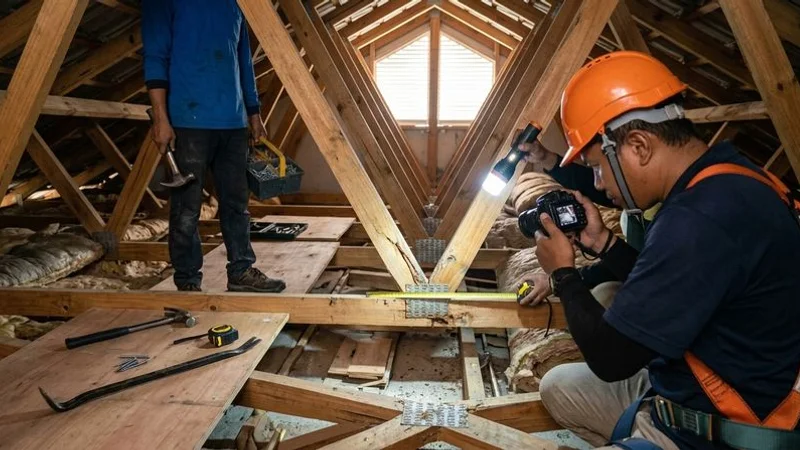
How Professionals Assess Truss Damage
Our assessment process always begins with a thorough, hands-on structural review. During a professional roof truss inspection, the contractor evaluates several crucial factors before recommending a path forward.
Damage Type
Different types of damage have drastically different implications for your building. We commonly encounter these specific issues in the Malaysian climate:
- Termite damage: The Asian subterranean termite (Coptotermes) is a top culprit, causing issues that range from localised attacks to widespread destruction.
- Water rot: This is concentrated around leak points, especially where timber meets masonry in high-humidity zones.
- Moisture content: Timber strength drops significantly once its moisture content rises above the critical 19% threshold outlined in Malaysian structural standards.
- Mechanical impact: Fallen branches or improper construction work usually crush specific sections.
- Overloading: Modifying your roof covering without calculations or storing heavy items in the cavity creates dangerous stress.
Modern structural engineers use moisture meters to detect hidden rot long before it becomes visible to the naked eye. Catching that hidden moisture early is the key to preventing a catastrophic collapse.
Damage Extent
The percentage of the affected structural system is a vital deciding factor. We look at these general thresholds when mapping out a plan:
- Less than 20% affected: Repair is almost always the preferred, cost-effective route.
- 20% to 50% affected: This middle ground requires a detailed cost-benefit analysis.
- More than 50% affected: Full replacement becomes the most practical and responsible solution.
Structural Significance
Not all members carry the same load, so the location of the rot matters immensely. Professional teams pay closest attention to the primary load-bearing members:
- Top chord (rafters): These carry the heavy weight of your roof tiles and battens.
- Bottom chord (ceiling ties): These stop your exterior walls from pushing outward under the roof’s massive weight.
- Web members (struts and ties): These smaller pieces distribute forces within the triangular frame.
- Connector plates: These are the metal joints that hold everything together at the nodes.
We consider damage to a primary top or bottom chord far more critical than damage to a secondary web member. Even if the physical rot looks identical, failing primary chords threaten the entire building structure.
When Repair Makes Sense
Truss repair involves strengthening weakened members without removing the entire assembly. We often recommend this route because it minimises disruption to the occupants below.
Sistering and Plating
Adding new material to the existing frame is a highly effective way to double its load capacity. Experienced carpenters typically use these two approaches:
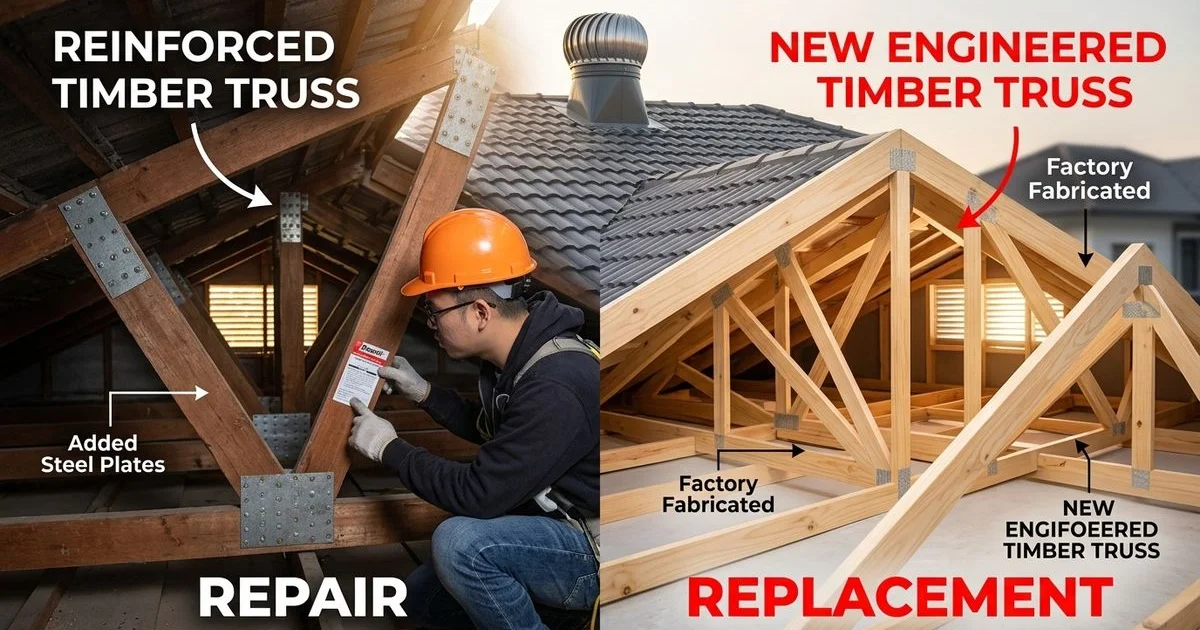
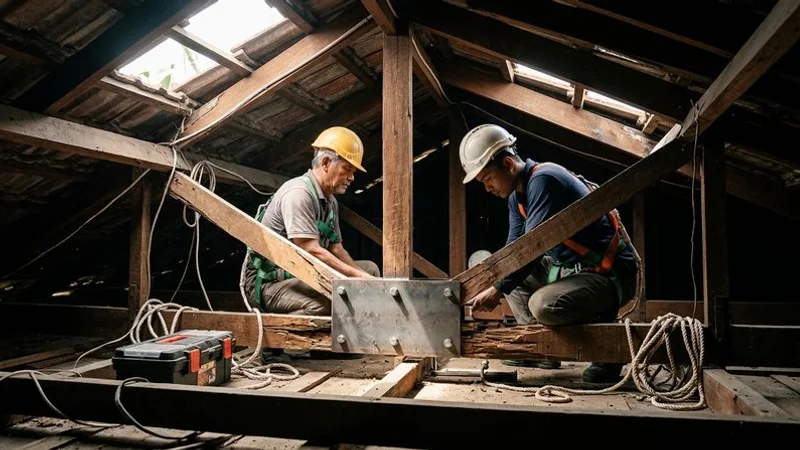
- Timber sistering: New timber is bolted directly alongside the compromised piece. This works beautifully for partially rotted members where at least half the cross-section remains solid.
- Steel plate reinforcement: Steel plates or angle brackets are bolted tightly across weak joints. This fixes corroded connector plates or localised impact damage.
- Load enhancement: Plating is also a great way to add strength before installing heavy solar panels or water tanks.
Epoxy Consolidation
Modern chemical treatments offer incredible structural support for historic or hard-to-reach timber. We frequently use high-performance structural adhesives, like the two-part Sikadur-30 or 31 SBA epoxy, to restore compromised wood fibres. The resin penetrates deep into the timber to create a bond strength that can reach up to 21 MPa with steel components.
This specialist technique is best suited for a few specific scenarios. Our teams use epoxy consolidation when preserving original heritage timber is a priority. It is also perfect for shallow termite damage where the core remains sound, or for awkward tight spaces where bulky sistering simply will not fit.
Cost of Repair
Financial considerations play a massive role in this decision. Our recent data shows roof truss repairs in the Klang Valley typically range from RM1,500 to RM8,000. Your final bill depends heavily on a few key variables:
- The sheer number of structural members requiring reinforcement.
- How easily our team can access the dark roof cavity.
- Whether we must partially remove the roof tiles to reach the rotting wood.
- The specific materials selected, such as specialised structural epoxy versus standard steel plating.
When Replacement Is Necessary
Full replacement requires removing the damaged frame entirely and hoisting a new one into position. We view this as a major, disruptive construction project, but sometimes it is the only safe option left.
Indicators for Replacement
Certain warning signs mean a simple patch job will no longer cut it. Our engineers mandate a complete replacement when we observe these critical failures:
- Widespread termite damage: Patching becomes mathematically impractical when pests have hollowed out multiple interconnected members.
- Severe structural deformation: A visibly sagging or twisted frame means the geometry has warped permanently, and no amount of epoxy can restore its original shape.
- Multiple failed joints: Separated connector plates at several points indicate the system has lost its engineered load path completely.
- Complete loss of integrity: If the wood crumbles instantly when probed with a screwdriver, there is no solid material left for new bolts to grip.
- Heavier roof coverings: Switching from a light metal deck to heavy clay tiles during a roof replacement demands new trusses built to a much higher load specification.
The Replacement Process and Council Permits
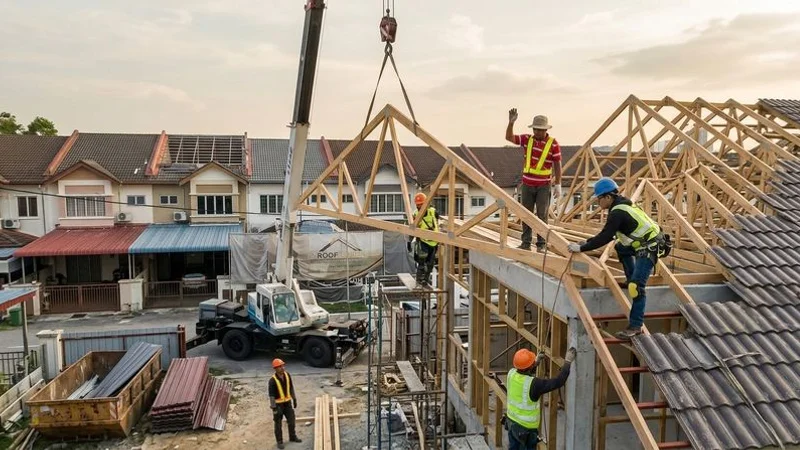
Tearing off a roof is a highly orchestrated process that requires strict safety protocols. We follow a precise sequence to protect your property during the swap:
- Temporary support: The ceiling and surrounding walls are securely propped.
- Covering removal: Existing tiles or metal sheets are carefully lifted and stored.
- Extraction: The old, damaged timber is sawed into sections and removed.
- New installation: A modern prefabricated frame is hoisted into the exact position.
- Connection and bracing: The new wood is locked to the wall plates.
- Reinstatement: Battens, underlayment, and the exterior covering are put back.
Navigating the local bureaucracy is just as important as the physical labour. Professional project managers must point out that Malaysian councils like DBKL or MBPJ enforce strict rules under the Uniform Building By-Laws (UBBL 1984).
Any project that alters the structural load or roof profile requires formal submission by a Principal Submitting Person (PSP), usually a registered engineer or architect. This mandatory OSC 3.0 Plus online permit process can take up to 90 days to approve, meaning you cannot legally start a full replacement on a whim.
Cost of Replacement
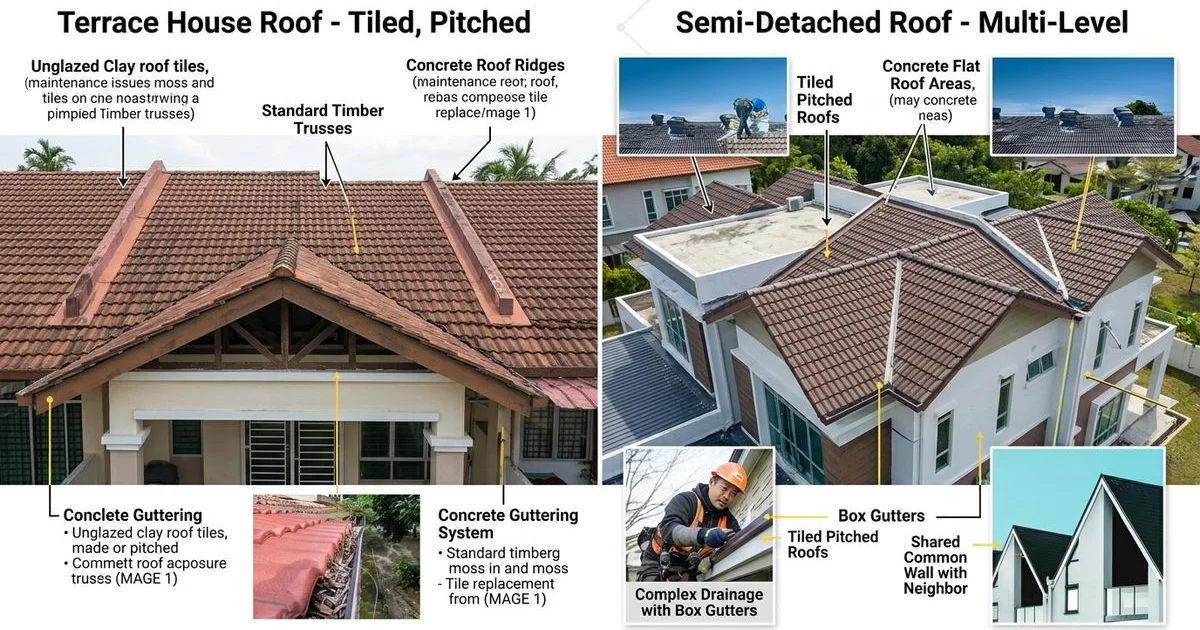
A brand new structure is a significant financial investment. We estimate that a full replacement for a standard Malaysian terrace house runs anywhere from RM5,000 to RM20,000 or more per truss.
The pricing fluctuates based on the span width, the complexity of the angles, and site accessibility. Corner lots are significantly easier to stage than mid-terrace units. You also have to factor in the professional fees for the structural engineer’s sign-off, which is legally required by the local council.
Cost Comparison Summary
Seeing the numbers side-by-side helps clarify the reality of both options. We have compiled this quick reference table to highlight the major differences in time, cost, and disruption.
| Factor | Repair | Replacement |
|---|---|---|
| Typical Cost (2026 est.) | RM1,500 to RM8,000 | RM5,000 to RM20,000+ |
| Project Duration | 1 to 3 days | 3 to 7 days (plus 90-day permit wait) |
| Disruption Level | Minimal to moderate | Significant interior exposure |
| Local Council Permit | Usually not required for minor work | Strict PSP submission via OSC 3.0 |
| Longevity | 10 to 20 years if moisture is solved | 30 to 50 years with treated timber |
| Roof Covering | Usually stays mostly in place | Completely removed and reinstalled |
| Best Application | Localised rot, strict budget limits | Widespread decay, permanent upgrades |
Making Your Decision
Making the final call feels overwhelming when your ceiling is actively showing signs of stress. We use a straightforward, five-step framework to help property owners lock in a confident, financially sound decision.
- Get a professional assessment first. Never make a major structural decision based solely on a quick visual glance from the ground. A qualified roof truss repair specialist will actually climb into the cavity to probe, measure, and document the decay.
- Demand dual quotations. A reputable contractor will gladly provide detailed pricing for both fixing and replacing the timber. They should offer honest, data-backed commentary on the pros and cons of each approach.
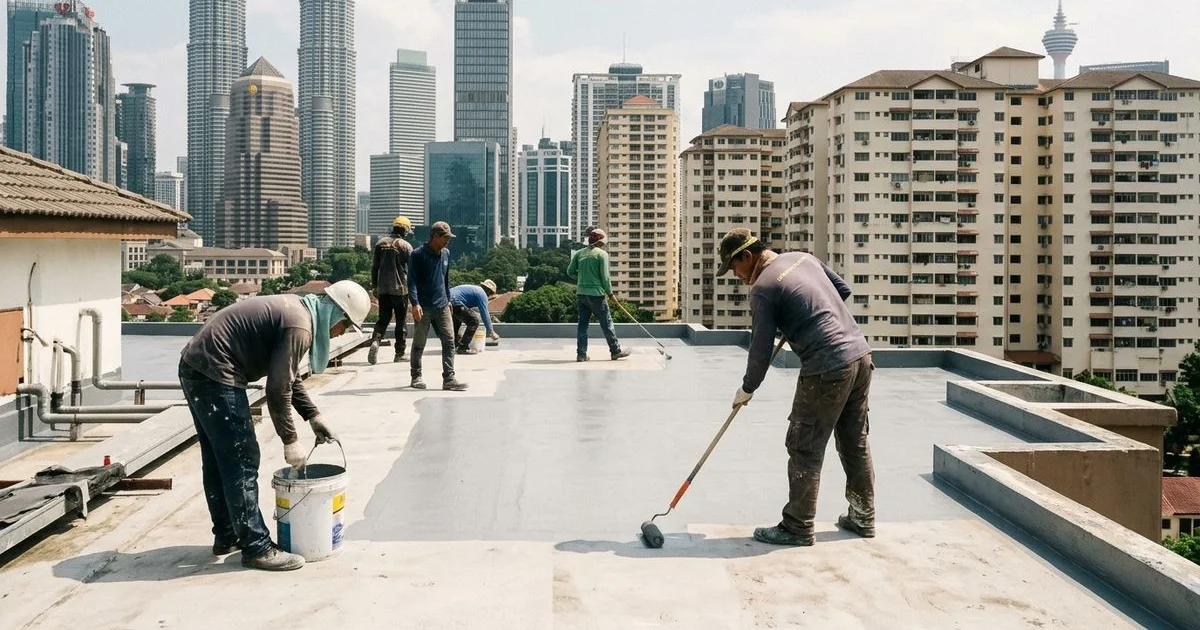
- Evaluate the roof covering lifespan. If your clay tiles or metal sheets are already decades old and cracking, fixing the frame below is only half the battle. We highly recommend addressing both the exterior covering and the interior framing simultaneously to save on future labour costs.
- Mandate pest treatment before construction. If subterranean termites caused the initial collapse, you must eradicate the colony first. There is zero logic in installing expensive new timber just to feed the same active pest infestation.
- Think about your long-term horizon. Consider how long you plan to own the building. A more durable, engineered solution usually delivers vastly superior value over a multi-decade timeline, even with a steeper upfront invoice.
The Bottom Line
There is no universal, copy-paste answer to the core question of Roof Truss Repair vs Full Replacement: When to Decide. The smartest path forward depends entirely on the measured extent of the rot, the condition of the surrounding masonry, and your long-term plans for the real estate.
We cannot stress enough that time is your biggest enemy here.
A compromised timber joint does not heal itself, and it will rapidly lose load-bearing capacity as moisture levels fluctuate. Whether you choose to reinforce the existing members with epoxy or opt for a totally new prefabricated frame, taking decisive roof repair action right now is guaranteed to be cheaper than cleaning up a collapsed ceiling tomorrow. Reach out to a licensed structural inspector today to map out your safest next step.
Farah Hassan
Technical Writer & Project Coordinator
Technical writer and project coordinator specialising in roofing education.